Ryan Anderson

Science, Fiction, Life

Page 15 of 16

Jupiter as the Moon

Have you seen this awesome set of pictures depicting what it would look like if you replaced our moon with each of the planets? I particularly like the images for Jupiter and Saturn – they absolutely dominate the night sky:

jupiter_as_moon

Jupiter, as it would look if it were our moon.

I always enjoy pictures like this: they are a great way to illustrate the relative sizes of the planets. But the following tweet made my skeptic senses tingle:

badfactcheck

Now, Ezra Klein is a smart guy, and I have followed his blog for a while for his excellent political coverage, which is nice and wonkish, with lots of graphs and charts. I’m a scientist, I like me some graphs and charts. But as much as his blog loves to factcheck political stuff, he failed to fact check this fact check.

The tweet in question says that the Earth and Jupiter would collide if they were the same distance apart as the Earth and the Moon. it’s not that this is wrong, but that it doesn’t state its assumptions and so it is misleading. I was tempted to reply on Twitter, but this is the sort of thing that, alas, involves lots of caveats so I thought it would be better to tackle it here.

The main question is what the motion of the two planets is when you suddenly replace the moon with Jupiter. If both planets are stationary relative to their center of mass, then yeah, they’re going to collide. But the same would be true of the Earth and the Moon. If the two planets have any angular momentum at all, they will orbit their center of mass rather than simply falling toward each other. So that means that in all cases except that in which the planets start at rest, they won’t hit each other.

But not quite. Because planets have some size. If they don’t have enough angular momentum, they will follow a very narrow elliptical orbit and will crash into each other. To avoid collision, there has to be enough angular momentum for the periapsis of the orbit to be greater than half the sum of the planets’ radii. I tried switching Jupiter for the moon, but otherwise keeping the angular momentum and orbital eccentricity of the system the same and I found that the periapsis is about 4400 km (I did this calculation quickly – my numbers might be off so feel free to check me!). This is too small to keep Earth and Jupiter from colliding, so the tweet is correct, given the assumption that the angular momentum and eccentricity of the system stays the same when you swap the moon for Jupiter.

But what bothered me was that the tweet could be read to imply that an Earth-sized object and a Jupiter-sized object could never comfortably orbit each other, and that’s just not true. With enough angular momentum, an Earth-sized object could be in a stable orbit around Jupiter.

So, let’s say the system has enough angular momentum for the Earth to stay in a stable circular orbit at the specified distance. What other misfortune might befall us? One possibility is that we would be inside the Roche limit and the powerful tides from Jupiter would tear us apart. I calculate the rigid-body Roche limit for Jupiter and Earth to be ~108,900 km, which is safely less than the Earth-Moon distance.

That’s not to say the tides wouldn’t do some weird things of course. Jupiter’s tides would still be huge and so it would raise enormous tides in our oceans and in the solid rock of the Earth itself. The friction generated by these tides would heat up the Earth’s interior (and probably trigger volcanoes and earthquakes in the process) and gradually slow the Earth’s rotation until one side of the earth was permanently locked facing Jupiter (the same thing has already happened to the moon, which is why we don’t see the far side except from spacecraft).

We would also be pounded by the intense radiation of Jupiter’s magnetosphere. Our magnetic field might protect us for a while, but as our spin rate slowed, our magnetic field would die, leaving us exposed. It’s possible that the radiation would then strip away our atmosphere, leaving the earth a desiccated and dead world. I’ll leave that calculation as an exercise for the reader.  Correction: our orbital period around Jupiter would actually not be much more than a day, so our magnetic filed would probably survive.

So, bottom line: the tweet in question is only sort of right. Earth could stably orbit Jupiter, just not with the same orbital parameters as the current Earth-Moon system. If we were in a stable orbit, there would be some… interesting side effects, which might prove to be deadly, but nothing as dramatic as crashing into Jupiter.

 

Liquid Hot Magma

Well, technically lava since magma refers to un-erupted molted rock. And technically technically it’s not erupted, it’s melted in a big furnace, so it probably isn’t lava either.

But yeah, bottom line: here’s a video of synthetic lava poured over a slab of ice. Science is awesome:

Book Review: Wool

2940014544085_p0_v2_s260x420

One of my favorite things is coming across a new book that I know nothing about and then proceeding to be completely consumed once I start reading, emerging days later blinking and disoriented as I am forced to reintegrate with the real world.

That’s more or less what happened with Wool. My wife and I were on a two week vacation in Peru (which was awesome) and before we left she asked friends for book recommendations. One of them suggested Wool, so we downloaded it on our Kindle and set off on our adventure.

Toward the end of the trip we started reading it in our hotel room (we read books out loud because we are unbearably adorable like that). By that point in the trip we had hit most of the main attractions in Cusco and were quite tired after almost two weeks of being adventurous. I feel a bit guilty admitting this but on our last couple of days we ended up spending hours just sitting in our room reading Wool instead of doing last-minute exploring.

Wool is a collection of five  related stories set in a post-apocalyptic world where everyone is forced to live underground in giant “silos”. It is the story of one silo starting to realize that, lurking beneath the life that they take for granted, there are some sinister forces working to maintain the status quo. As the tagline on the cover says, “If the lies don’t kill you, the truth will.”

The first story is really quite sad and dark. At one point in the first story when we took a break from reading, my wife commented on how incredibly sad the story was. But then immediately demanded that I keep reading. Because despite the dark tone, Wool is a masterful example of how to use building dread and suspense to keep readers turning the page.

The premise for the story is nothing particularly new. I was reminded very strongly of the video game Fallout 3, which begins in an underground facility where people have lived for generations to avoid the dangers of a surface world rendered nearly uninhabitable by nuclear war. However, Fallout 3 is a video game and its main concern is with setting up the appropriate ambiance for the world and then getting the player out into the unknown world beyond the door of the Vault. It is a testament to how good Fallout 3 is that a brief encounter with the Vault leaves such a strong impression, but there’s not actually much there.

Wool on the other hand is a wonderful example of science fiction worldbuilding. The action takes place (almost) entirely in the silos and details of the civilization that lives in them are doled out perfectly, making the reader constantly want to know more, but at the same time providing exactly as much information as the reader needs. No awkward info dumps in sight, just a vivid world perfectly revealed.

Of course, the stories are really about the characters and again Wool does a great job. The stories are not sweeping epics, but instead focus closely on a handful of well-drawn characters. I was especially impressed by the careful, skillful, and realistic way in which characters falling in love is dealt with.

The limited scope, both in terms of number of characters and the enclosed, sometimes claustrophobic world in which they live, is a real strength of the stories. There are no wasted words here. The writing is really tight: everything that is mentioned is mentioned for a reason. It all hangs together incredibly well and makes for a really compelling read.

My only nitpick is that the end of the final story comes a bit abruptly. Still, it’s a small nitpick in what is otherwise one of the best books I’ve read in a long time. Check it out, especially if you are a fan of post-apocalyptic sci-fi. you won’t be disappointed.


Consolidating

Hello and welcome to my new personal blog. In the past I have been known to blog elsewhere, most notably at The Martian Chronicles over at the AGU blogosphere, but also at my short-lived blog about the Science of Starcraft where I looked at real-world science in the Starcraft video game series, and occasionally at Science in my Fiction. I haven’t posted much at any of these sites lately, so in an effort to consolidate my web presence and also perhaps revitalize my blogging, I’m starting up a personal blog here at my home page. I’m hoping that freeing myself from the restriction in subject matter that was inherent in my other blogs, I will be able to rekindle my blogging habit and hopefully keep readers from my previous blogs engaged. We shall see. You’ll notice that I have imported my archive of posts from Science of Starcraft to this blog. That’s because I’m going to be shutting down the actual science of Starcraft site.

What to expect on this blog? Oh, this and that. Some science certainly. Likely lots of posts about speculative fiction, including reviews of books, movies, and games, and samples of my own projects. Maybe some personal posts too. The main point is, this blog does not have a specific topic built into its title, so that frees me to write about what I want when I want to. It should be fun!

How do Zerg Fly in Space? Part 1: Mutalisks

Ok folks, it’s time. We’ve all asked this question, but I’ve been putting off answering it because we all actually know the answer.

How do the Zerg fly in space?

Magic.

There’s a certain point in sci-fi or fantasy where you have to just suspend disbelief and go along for the ride, and I think that the Zerg ability to travel through space is a good example of this. That said, I’d like to take a look at one of the most common explanations that people give to justify the mutalisk’s ability to flap its wings and propel itself through space. As you’ll see, it’s completely implausible.

Now, we know that flapping doesn’t do anything in a vacuum: there’s nothing to provide any resistance, so you can flap all you want and it won’t move you forward. But what if mutalisks used their dragon-like wings as solar sails, catching the photons from a nearby star to cruise through interplanetary space? That might not explain the flapping, but it could explain how they can move, so let’s take a closer look.

The idea behind solar sails is the conservation of momentum. Even though photons of sunlight have no mass, they do have momentum. High school physics tells us that momentum is conserved, so if you have a bunch of photons with momentum being absorbed by a solar sail (or a mutalisk’s leathery wing) then their momentum must be transferred to the thing they’re hitting, exerting a force on it and causing it to move through space. So, how large would a mutalisk’s wings have to be to let it accelerate at a reasonable speed? To figure this out, we need to do a back of the envelope calculation, making some assumptions about how big mutalisks are.

In general, the sizes of units in the game are not reliable: I prefer to consider the cinematics as the authoritative source. So let’s take a look at this cinematic showing Jim Raynor’s battlecruiser being attacked by a swarm of mutalisks.
[youtube=http://www.youtube.com/watch?v=pOh1YoaPbi0&w=640&h=385]

At about six seconds, one of the mutalisks flies over the right-hand side of the battlecruiser and crosses near a long row of windows. Based on its size compared to the set of windows, I would say that the creatures have a wingspan of around 100 meters and that their tube-like body is about the same length and maybe 5 meters across. If mutalisks are like most earth life, then they are mostly water. to get a rough idea of their weight we can calculate their volume and then multiply by the density of water. A cylinder 5 meters by 100 meters has a volume of about 2000 cubic meters. That would correspond to a whopping 2,000,000 kg or 2000 metric tons!

Now, obviously that’s too big for something to fly in at atmosphere, let alone in space by flapping its wings. But lets be generous and say that maybe mutalisks are made of some very low-density material, and maybe I overestimated their size. What if they were closer to 20 tons? How much oomph would their wings give them if they used them as solar sails. Again I’ll be generous and treat the wings as a square of material 100 meters on a side.

The momentum of a photon is given by: Momentum = Energy/Speed of Light, so near a sun-like star, where most photons are in the visible range, they have an energy of 2-3 electron volts, yielding a momentum of 1.6×10^-27 kg m/s per photon. That’s not much, but a star puts out a lot of photons, so let’s see if that balances it out and gives us a decent thrust.

Let’s say our theoretical mutalisk is orbiting the sun at the same distance as Earth, 150,000,000,000 m from the sun. The sun puts out 3.8×10^26 watts or roughly 8×10^44 photons per second, but that power is spread out in all directions. To figure out how much hits our solar-sailing mutalisk, we have to imagine spreading that power out over a sphere the size of our mutalisk’s orbit with a surface area of 4*pi*R^2 where R is the radius of the orbit. That gives 2.25×10^20 photons per square meter per second.

Solar sails don't make for the most maneuverable spacecraft, and they would be sitting ducks in any sort of space battle.

With a wing area of 100 m x 100 m (10,000 square meters), our mutalisk would intercept around 10^24 photons per second, corresponding to a whopping force of 0.0004 newtons! That’s enough force to accelerate a 20 ton mutalisk up to about 14 miles per hour in a year.

Edit: An astute reader points out that the size of mutalisks is described in the Starcraft novels as being much smaller than I described. They apparently have a wingspan of 20 feet and are only 7 feet long and about a meter across. to me that seems shockingly small, especially compared to the cinematics, and it also seems quite stubby compared to all of the art depicting mutalisks as having a body that is a long tube. Still, we can scale the above results to fit these new dimensions. Given a cylinder 7 feet long and 3.3 feet across, and again assuming a density like water, I get a mass of 1.7 metric tons. If we treat the wings generously as a 20 foot square, then their surface area is 37 square meters, so the thrust on wings of that size as compared to our 10,000 square meter example above would be .0004 newtons x .0037 = 1.5×10^-6 newtons. That’s enough to accelerate our 1700 kg mutalisk all the way up to 0.06 miles per hour in a year! Even assuming a much lower density, it would only accelerate a 170 kg mutalisk up to 0.6 miles per hour in a year.

You might not have followed every step of that (admittedly very crude) calculation, but that final value should give you some idea of how ridiculous it is to say that a Mutalisk’s wings could work as solar sails. Even assuming very large wings and a small body, the acceleration that you get is miniscule. Plus, solar sails are really only good for accelerating away from the star, and Mutalisks are like fighter jets: they need to be able to dodge and weave in all directions very quickly.

Bottom line, I can’t explain how the mutalisks fly in space. Heck, I can’t explain how something that big flies in air! Solar sailing certainly doesn’t cut it, so we’re left where we began. It’s magic. This is a part of the Starcraft Universe that just doesn’t fit with the laws of physics in our own universe, and that’s fine. Mutalisks are still cool, and it’s not like I’m going to stop playing Starcraft because I don’t know how they can fly in space.

Stay tuned: next I’ll take a look at all the non-winged Zerg fliers!

The Color of Acid

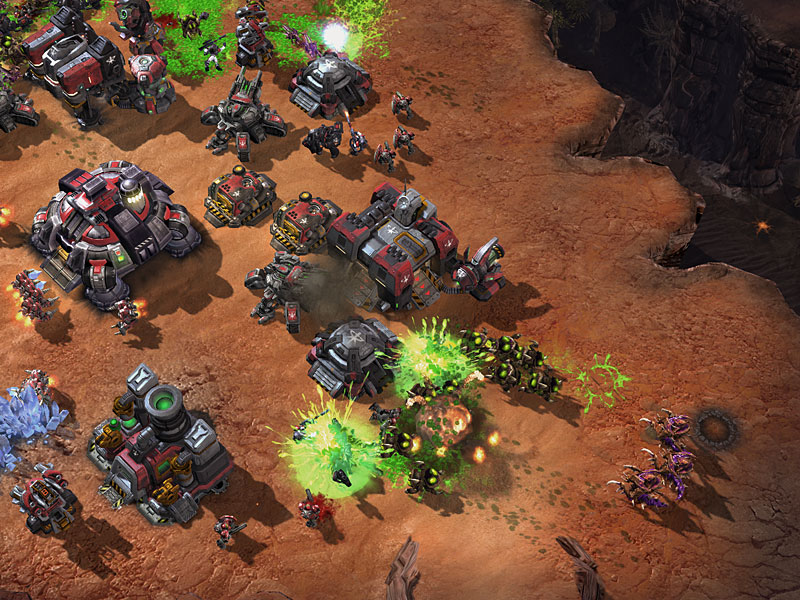
The other day I was playing Starcraft 2 and trying to think of the next topic to tackle here. As I watched a swarm of zerg roaches attack a group of terran marines, I realized that I needed to talk about acid. Two of the new zerg units, the baneling and the roach have acid-based attacks. The baneling is a little suicide bomber that detonates, splashing corrosive acid all over nearby units, while the roach is a nasty armored insect that spews a stream of acid on its foes from a distance.

Banelings doing their thing.

I like both of these units in the game, but they perpetuate a myth about acid that has infested pop culture for years: it is bright neon green. I’m not sure where this idea originated. Maybe it goes back to World War I, when chlorine gas was used as a chemical weapon. It’s not an acid, but it is a nasty caustic chemical that is a sickly green color. Or maybe the green acid idea can be traced back to the movie Alien, where the alien is revealed to have highly acidic blood that looks greenish yellow.


The famous shot of the alien's acidic blood in Alien.

Whatever the origin of the idea, it’s patently false. Most acids are colorless in both their pure form and in solution. Sulfuric acid? Colorless. Hydrochloric acid? Wikipedia says that it is colorless to light-yellow, but I’ve never seen an example that showed any color. Hydrofluoric acid? Colorless.

I don’t know of any acid that is brightly colored, though I admittedly not a chemist. There are probably some nice, colorful organic acids, and it’s certainly possible for acid to be mixed with other colored stuff in a solution, but in the real world acid does not conveniently advertise its corrosiveness by being bright green.

While we’re on the subject, let’s talk about the plausibility of an insect spraying acid, whatever the color may be. This is actually plausible to me. There are plenty of examples of insects that are armed with chemical-based weapons. One of the most famous is the bombardier beetle, which defends itself by blasting a nasty, boiling hot liquid at its attackers. Bee venom contains formic acid, and many ants inject or spray formic acid or other chemicals when they bite.

If we’re willing to suspend disbelief enough to allow the zerg to exist in the first place, I’m also willing to grant that they might use caustic chemicals to attack, since real-world insects do this too.

Starcraft 2 Review

Well folks, I finally beat the campaign in Starcraft 2 last night, so I finally feel comfortable reviewing the game.

In a lot of ways, Starcraft 2 is very similar to its predecessor, and I think on the whole that’s a good thing. With the original Starcraft, Blizzard hit on a formula for a compelling game that just worked, so they didn’t need to fix it. With Starcraft 2, they tweaked it instead. There are a lot of familiar units in the new version of the game, but there are also a lot of new ones, as well as new abilities for familiar units that make things interesting. There are also a lot of tiny, careful changes to the gameplay that make everything flow more smoothly.

Tychus Findlay and Jim Raynor at the bar.

For me, the campaign was always the highlight of the original Starcraft and I’m happy to report that it is excellent in Starcraft 2 as well. The story focuses on Jim Raynor who has had a make-over and is now a rugged, scarred mercenary. Instead of a linear storyline with little player choice like in the original game, Starcraft 2’s missions allow a little more flexibility: at any given time there are several missions to choose from. Between missions, you can interact with other characters on your ship. Head to the cantina and share a drink with Tychus Findlay, a rough-and-tumble ex-convict marine. Or go to the lab and see what new technologies Egon Stetman, the stereotypical squeaky-voiced, lab-coat-wearing, socially-awkward scientist has cooked up for you. Or check out the armory and ask Rory Swann – the mechanic who sounds like he belongs on Car Talk and looks like a Warcraft dwarf – to upgrade your mechanical units. Other colorful plot-related characters include the awesomely stereotyped Tosh – a rastafarian rogue ghost operative, complete with voodoo charms and a “ya mon” accent – and the idealistic young ship’s captain Matt Horner, whose clean-cut look and fancy uniform were carefully designed to contrast with Raynor’s bad-boy tattooed arms and sweat-stained t-shirt.

Tosh, the suspicious Jamaican operative. Yes, that is a voodoo doll around his neck.

This interesting bunch of characters  send you on missions following several parallel plotlines that gradually intertwine to lead to the requisite huge battle at the end of the campaign. Each thread of missions is based on that character’s personal interests, and things get interesting when some of the characters disagree on what’s the best next step. All of these interactions are done really well using rendered-on-the-fly cutscenes. Some of these cutscenes are cinematics in their own right (at one point there’s a bar fight which was very well done) but there are also a few of Blizzard’s trademark spectacular pre-rendered cinematics for key plot points.

I really enjoyed the interplay between the missions and the “down time” on the ship: each mission gives you a new type of unit, some “research points” and some cash. The new unit is then available in all future missions and the research points and cash can be used to upgrade your units and hire mercenaries to help you. This adds another layer of customization to the game that worked really well.

Jim Raynor, Matt Horner and Tychus Findlay on the bridge of the Hyperion.

I also loved the variety of the actual campaign missions themselves. There are actually very few missions where you just build an army and destroy the enemy. There’s always something more going on. In one level, lava floods the low ground every few minutes. In another level, hordes of zombies attack you at night, and you have to hold the line until daybreak, when you can take the fight to them. The “hero” levels, where you just get a handful of special units to achieve your obectives, are really excellent too.

The story itself, like the story for the original Starcraft, is passable but not great. The problem with video game stories in general is that they exist primarily to get you to the next mission, so they are often not as developed as one might hope. Compared to most video games, Starcraft 2 has a very good story. Compared to most novels, it’s pretty weak. The writing is mediocre at times as well, with plenty of cliched lines and heavy-handed character development. But it gets the job done, and the fact that there are actual characters, and that they do develop a bit, is actually a great thing to see in a game!

The cantina. You can play some sweet tunes on the jukebox, or watch the latest amusing news broadcast from the Starcraft analog of Fox News.

A final aspect that I want to mention is the overall “feel” of the campaign. There was a certain Firefly-like “space western” vibe going on that I really enjoyed. This shows in everything from the (very good) in-game music, to the characters of Jim Raynor and Tychus Findlay (roughly analogous to Malcom Reynolds and Jayne Cobb in Firefly) to the jukebox on the ship that plays down-home favorites like “Sweet Home Alabama” and “A Zerg, A Shotgun and You“.

Bottom line, Starcraft 2 is a great game. The loving attention to detail that went into every aspect of the game is obvious. The campaign is full of really well-designed missions that lead you through several strands of an intertwining story to an exciting conclusion. The ability to customize your units between missions adds a nice dimension to the gameplay, as does the ability to interact with the various colorful (if blatantly stereotyped) characters on the ship.

And of course, once you’re done with the campaign, there are limitless hours of multiplayer fun to be had. You can work your way up the competitive ladder, or take advantage of the extremely powerful map editor that comes with the game and play custom maps made by other players, some of which are good enough to be separate games in their own right.

If that’s not enough, there are two expansions in the works. The campaign in Starcraft 2: Wings of Liberty is strictly Terran (with a few protoss missions thrown in). Each of the two expansions will focus on one of the other races in the Starcraft universe. I don’t think there are release dates set for the expansions yet, but it’s pretty clear that Starcraft 2 and its expansions will be keeping us busy for a long, long time.


Some of the pre-mission loading screens are pretty awesome too.

What is a Gauss Rifle?

A couple weeks ago I took a look at railguns, how they work, and how the ones depicted in Starcraft 2 don’t look much like the real thing. This week I’d like to look at another favorite exotic gun in sci-fi video games: the gauss rifle. In Starcraft, the marines carry gauss rifles that act much like real-world assault rifles. In other games, like Fallout 3 and the Mechwarrior series, gauss rifles are a sniper weapon, used to do lots of damage at a distance with a single shot. So, what is a gauss rifle, really? And is it anything like those depicted in the games? Continue reading

What is a Supernova?


The splash screen for the 'Supernova' mission in Starcraft 2.

Everyone has heard of supernovae, but it seems like there is some unwritten rule that they must never be depicted correctly in popular sci-fi. Starcraft 2 is, sadly, no exception. I don’t think it’s too much of a spoiler to say that there is a mission in the campaign where you have to battle your enemies to gain control of a relic on a planet that is about to be consumed by the fires of a huge blue star that is “going nova”. Or supernova. The words are used interchangeably.

As an astronomer, I always cringe when this happens, so I want to clear up what exactly supernovae and novae are.

The confusion is understandable: both are stellar explosions, and their names imply that a supernova is just a big nova. But in most cases this isn’t true. Let’s consider supernovae first, since by understanding them we will already be well on our way to understanding novae.

A supernova is when a very large star explodes. But that’s the end of a long process, so let’s rewind to the beginning: a star starts off as a ball of (mostly) hydrogen gas that is compacted into a dense sphere by its own gravity. At some point, the immense pressure of all that hydrogen is enough to force the atoms in the star’s core to collide with one another and merge into helium, releasing a huge amount of energy. This process is called fusion, and for most of a star’s life, it sits there turning hydrogen into helium and producing lots of energy. That energy makes the star so hot that it glows, and it also provides the pressure that keeps gravity from crushing the star any more. Most stars are poised in perfect balance with gravity trying to compress them and the nuclear reactions in their cores trying to expand them. Continue reading

What is a Rail Gun and How does it Work?

A swarm of diamondbacks fire their "railguns" at a train.

In the Starcraft 2 campaign, there is a unit called the “diamondback”. It’s a sort of hovertank, and it is useful for hunting down other vehicles because it is armed with dual “rail guns” that can fire while it moves. In the game, the rail guns are depicted as some sort of energy weapon: they fire hot blue beams at the target. This disturbed me because rail guns actually do exist, and they most certainly don’t fire blue energy beams!

So what’s a real rail gun and how do they work? I’m so glad you asked!

Continue reading

« Older posts Newer posts »

© 2026 Ryan Anderson

Theme by Anders NorenUp ↑